
A website can be absent from your search because the page is not indexed or because it is not appearing for that particular query. Start by checking the exact URL in Search Console, then investigate the evidence for the relevant branch.
A missing homepage, an unindexed service page, and a page that ranks below the results you checked can look like the same problem. Diagnose the specific URL before choosing a fix. This guide concerns organic website results and uses hypothetical examples rather than client performance claims.
Are you checking organic results or Google Maps?
First identify where the business is missing. A normal organic listing, a Google Maps result and a paid advertisement are different search surfaces. This guide addresses ordinary website results.
Write down the exact phrase you searched, the expected page, the country and the device. Also record whether you searched the business name or a competitive service phrase. These are different observations and may lead to different investigations.
For example, an illustrative business owner might find the homepage for the brand name but not find a service page for a broad commercial term. That does not establish that the service page is unindexed. Check the URL before choosing an indexing fix.
For help with an eligible Business Profile and local visibility, see our local SEO services.
How do you check whether the page is indexed?
For a website you manage, open the verified Search Console property and use URL Inspection:
- Copy the complete page URL, including its hostname and path.
- Enter it in the inspection bar.
- Read the stored result and expand the page-indexing details.
- Record the status, last crawl date if available, and canonical information.
Check the actual service page, not only the homepage. The status of one URL does not describe the entire website.
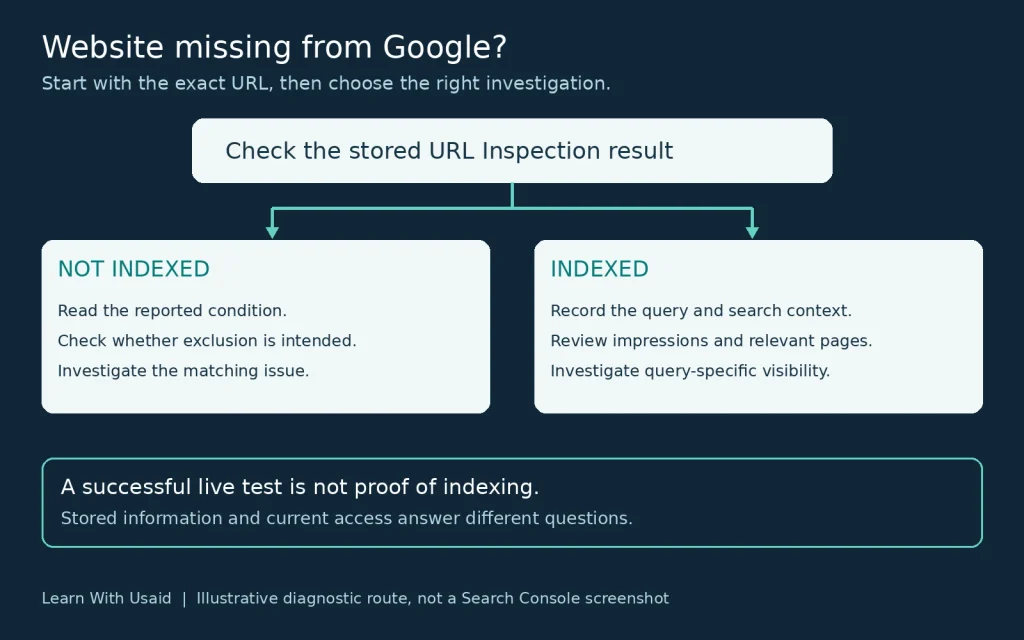
How is the live test different from the stored result?
The stored result describes Google’s recorded information. The live test checks the page as it is available now; it does not prove index inclusion or test every requirement for appearing in search.
| View | Question it helps answer |
|---|---|
| Stored inspection result | What does Google currently report about this URL in its index? |
| Live test | Can the current page pass the tested access and indexability checks? |
For the tool’s limits and result definitions, use Google’s URL Inspection documentation.
What should you do if the page is not indexed?
Match the investigation to the reported condition:
| Reported condition | Meaning or question | Next investigation |
|---|---|---|
| Crawled – currently not indexed | Google crawled the page but has not indexed it. | Review the page and template evidence; the status alone does not prove low quality or a penalty. |
| Discovered – currently not indexed | Google knows the URL but has not crawled it yet. | Review access, discovery paths, and relevant server evidence. |
| Blocked by robots.txt | Is the restriction intentional? | Inspect the matching crawl rule before changing it. |
| Excluded by noindex | Should this public page be excluded? | Check the directive and its source. |
| Alternate or duplicate page | Is another version correctly preferred? | Compare the URLs and canonical selection before treating this as a problem. |
Before correcting an exclusion, decide what the URL is for. A useful public service page and an account-only utility page may have different intended outcomes. Do not remove every restriction to make a report look cleaner.
Use Google’s Page Indexing report as the reference for the state, then follow the matching investigation rather than applying one universal fix.
See Google’s Page Indexing report guidance for each status. Keep intentional exclusions separate from useful public pages that need investigation.
Understanding what technical SEO includes can help you separate crawl access, content delivery, and URL-selection issues before changing settings.
What if the page is indexed but absent for your query?
If the page is indexed, investigate visibility for the particular search rather than immediately changing crawl controls.
Record the query, country, device, and intended page. Review available Search Console impressions and clicks using comparable periods. Check whether a different page appears for that topic, then assess whether your intended page answers the searcher’s need.
For example, someone searching for a consultant may need service scope, relevant experience, and a way to make contact. A definition-only page may not meet that need. This is a hypothetical content-purpose mismatch, not evidence that a specific website has been penalized.
Did the website disappear after a recent change?
Separate a new site from an established site with a measured decline. Record when the decline began, which pages are affected, and whether a redesign, URL move, content edit, or measurement change happened nearby. Also consider demand and search-result changes.
A nearby release date is a lead to investigate, not proof of causation. Preserve the old and new URL details so the next check can test a specific explanation.
| Record | What to write down |
|---|---|
| Timing | First observed decline and release date |
| Scope | Affected URLs, directory, or whole site |
| Change | Old URL, new URL, template or content edit |
| Evidence | Comparable report periods and observations |
Google’s traffic-drop guidance describes several possible causes and ways to investigate them.
Should you request indexing or wait?
Requesting indexing can be appropriate for a new or meaningfully updated page after its relevant checks are complete. For multiple pages, review the sitemap workflow. A request does not guarantee inclusion or make repeated submissions a reliable shortcut.
Follow the guidance for the actual status. Google’s explanation of Crawled – Currently Not Indexed says routine resubmission is unnecessary for that state.
Keep a dated note of what changed and when it was requested or submitted. Continue monitoring the relevant report instead of making another unrelated edit whenever the status remains unchanged. A recorded sequence makes it easier to distinguish a verified correction from normal reporting or processing time.
Follow Google’s recrawl-request guidance. There is no guaranteed deadline, and repeated requests for the same address do not make crawling faster.
What evidence should you provide when asking for help?
A useful handoff includes the affected URLs, intended searches, recorded inspection results and recent changes. Explain which pages matter to the business and why. Include screenshots only when they show the relevant property and date without exposing unnecessary account information.
You can describe the problem in a short, specific form: “This service page is intended for this query. Here is the recorded status, the first observed date and the change that happened beforehand.” Leave unknown fields marked unknown.
If the evidence points in several directions, a website SEO audit can bring the technical, content and measurement findings together before you commit to implementation.